
The Complete Guide to Resource Allocation Software
Resource allocation in organizations often occurs reactively through inefficient methods like emails and manual tracking, leading to significant issues such as mismanagement of personnel and wasted time. This can harm client trust and cost money, prompting a surge in demand for smart resource allocation software. Automated tools are being adopted by businesses seeking to optimize productivity and minimize operational confusion. This blog addresses the vital challenges of resource allocation, presents effective solutions and essential features, and highlights best practices, emphasizing best HRMS as a premier resource allocation management system for contemporary HR teams.
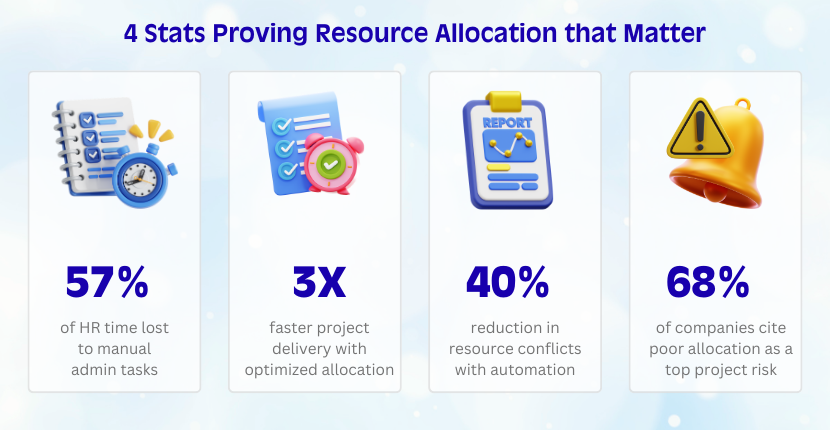
What Is Resource Allocation Software?
Software for resource allocation aids businesses in organising, allocating, tracking, and maximising the use of human resources across teams and projects. A centralised, data-driven method that guarantees the appropriate people—with the right skills—are always on the right projects takes the place of dispersed spreadsheets and conjecture.
Why Companies Need a Resource Allocation Management System
The complexity of managing employees across numerous projects, teams, and business units becomes unmanageable by hand as firms expand. A resource allocation management system reduces delays, avoids burnout, and maximises your workforce's return on investment by providing structure, clarity, and efficiency to this complexity. Organisations operate blindly without it, responding to issues rather than averting them.
The Resource Allocation (RAS) module of the Digital HRMS ecosystem is specifically made to automate the resource allocation process, guaranteeing transparency, optimal utilisation, and a smooth experience for RAS Providers and HR administrators alike.
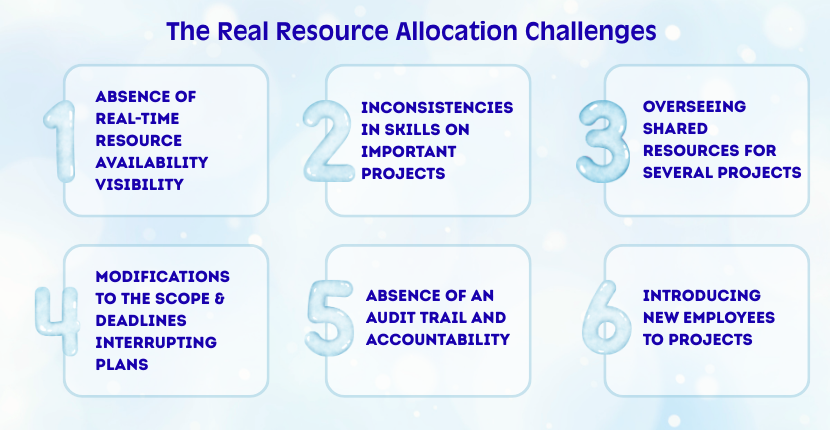
The Real Resource Allocation Challenges in HR
- Absence of Real-Time Resource Availability Visibility
Project managers and HR have no real-time visibility into who is shared across several projects, who is overworked, and who is free. Outdated information is used to make decisions, which causes delays and disputes.
- Inconsistencies in Skills on Important Projects
The wrong personnel are assigned to projects in the absence of employee skill-based resource allocation. High performers burn out while others are underutilised, tasks take longer, and quality declines.
- Overseeing Shared Resources for Several Projects
Errors are unavoidable when staff work on multiple projects at once, making it difficult to monitor their allocation percentage and avoid overcommitting.
- Modifications to the Scope and Deadlines Interrupting Plans
Projects evolve. However, the majority of manual systems are unable to adjust quickly enough. When priorities change, reallocating resources takes days rather than hours, which results in cascading delays.
- Absence of an Audit Trail and Accountability
This resource was assigned by whom? When? Why? These questions remain unaddressed in the absence of a system. When allocation choices are not tracked and logged, compliance and audit readiness suffer.
- Introducing New Employees to Projects
Without a centralised system, assigning new hires to the appropriate teams and projects is a disorganised procedure that delays their productivity and adds to the workload of HR administrators.
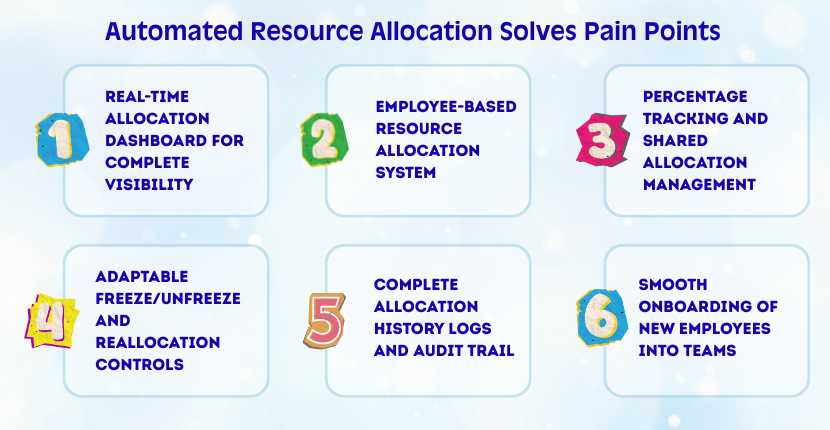
How Automated Resource Allocation Fixes These Problems
Applying a specially designed, automated resource allocation system is the solution to each of the above problems. Here's how each issue is addressed straight away by a suitable standardised software.
1. Real-time Allocation Dashboard for Complete VisibilityDedicated shared allocation views prevent overcommitment and make task balancing simple by displaying precisely which personnel are divided among projects and at what proportion.
HR administrators may easily remove, alter, or reassign resource allocation from a single interface as projects change. When stability is required, the freeze and unfreeze features lock schedules.
5. Complete Allocation History Logs and Audit Trail
Every allocation action, including who was allocated, when, and to which project, is documented. This establishes an unbreakable audit trail that promotes accountability, transparency, and compliance.
6. Smooth Onboarding of New Employees into TeamsThrough the RAS module, administrators may directly onboard new hires into projects and allocate them to the appropriate business units straight away, greatly cutting down on ramp-up time.
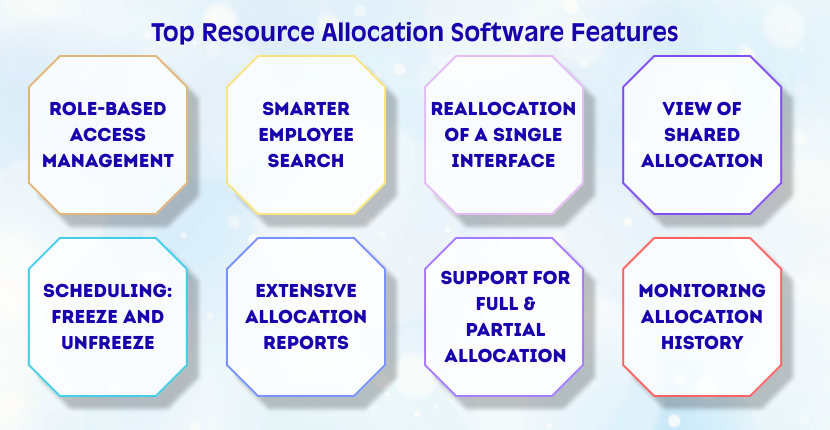
Key Resource Allocation Software Features
Role-Based Access ManagementAllocation data is managed and viewed by administrators. RAS providers only have access to the resources of their business units, protecting data and streamlining processes.
Smarter Employee SearchLocate any employee quickly using their name, department, skill, or availability status. Cut the time it takes to allocate from hours to minutes.
Reallocation of a Single InterfaceA dedicated view that prevents overloading and displays real-time allocation percentages for staff members working on several projects at once.
Scheduling: Freeze and UnfreezeFor ongoing projects, lock allocation matrices to stop unwanted modifications. Get alerts about unfreeze requests that are still pending.
Extensive Allocation Reports
For total workforce insight at any time, create reports that are filtered by project, business unit, date, availability, capability rating, and more.
Support for Full and Partial AllocationEmployees can be assigned 100% to one project or divided among several: the system tracks both situations as well.
Monitoring Allocation HistoryAny resource's whole allocation history is viewable by RAS providers, facilitating improved decision-making and offering a clear audit trail.
What are the Best Practices for Resource Allocation in HR Software?
The first step is to have excellent software. Step two is to use it correctly. High-performing companies adhere to these best practices for allocating resources in HR software.
Keep Your Skill Profiles Up to Date
Update the skills and capability ratings of your staff. Better matches come from better profiles.
1. Make a Proactive Allocation PlanDon't wait for the project to begin. In order to prevent chaos, allocate resources during the planning phase.
2. Track Utilisation Every WeekTo identify overloads and underuse before they affect delivery, review allocation data every week.
3. Establish Explicit Allocation RolesDon't allow allocation decisions to be made informally; instead, clearly assign RAS Provider responsibilities.
4. Use Freeze for Final PlansOnce verified, lock allocation matrices to avoid impromptu modifications that interfere with delivery schedules.
Use reports to spot trends, such as which teams are consistently overworked or which skills are always in short supply.
Why Digital HRMS Is the Resource Allocation Management System You've Been Looking For
All of these features are combined into a single, smoothly integrated Resource Allocation (RAS) module in Digital HRMS, which is specifically designed for HR teams overseeing intricate, multi-project workforce situations.
In contrast to conventional project solutions, Digital HRMS gives you a really comprehensive view by directly connecting your resource allocation with employee profiles, attendance, talents, and organisational structure. Your admin has complete control, your RAS providers have an easy-to-use single interface, and your entire company has the transparency it needs to run smoothly.
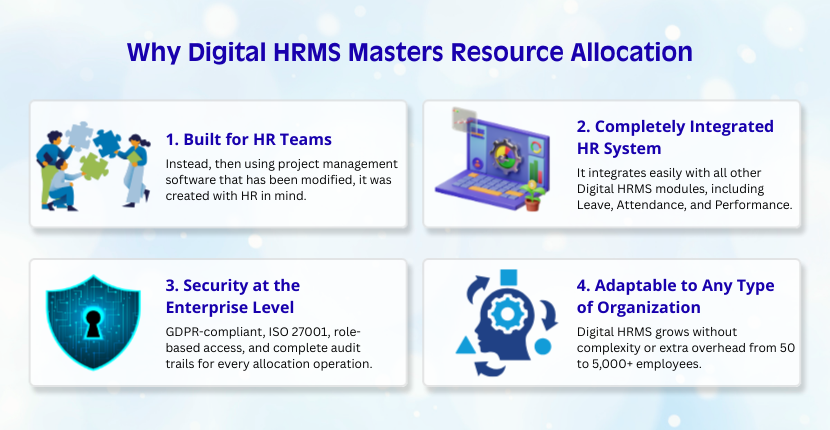
- Built for HR Teams
Instead, then using project management software that has been modified, it was created with HR in mind.
- Completely Integrated HR System
It integrates easily with all other Digital HRMS modules, including Leave, Attendance, and Performance.
- Security at the Enterprise Level
GDPR-compliant, ISO 27001, role-based access, and complete audit trails for every allocation operation.
- Adaptable to Any Type of Organization
Digital HRMS grows without complexity or extra overhead from 50 to 5,000+ employees.
Conclusion
Allocating resources is a critical strategic function in Human Resources (HR) that has a big impact on project completion, worker satisfaction, and overall business expansion. Allocating resources effectively sets high-performing companies apart from their competitors. For companies looking for effective, data-driven HR operations, the shift from manual, reactive methods to automated resource allocation utilising specialised software is crucial. The Resource Allocation System (RAS) module of the Digital HRMS offers extensive features to simplify this procedure, removing the difficulties frequently connected with enterprise HR software. This module gives HR and project teams the clarity, control, and assurance they need to regularly assign the correct people to projects.